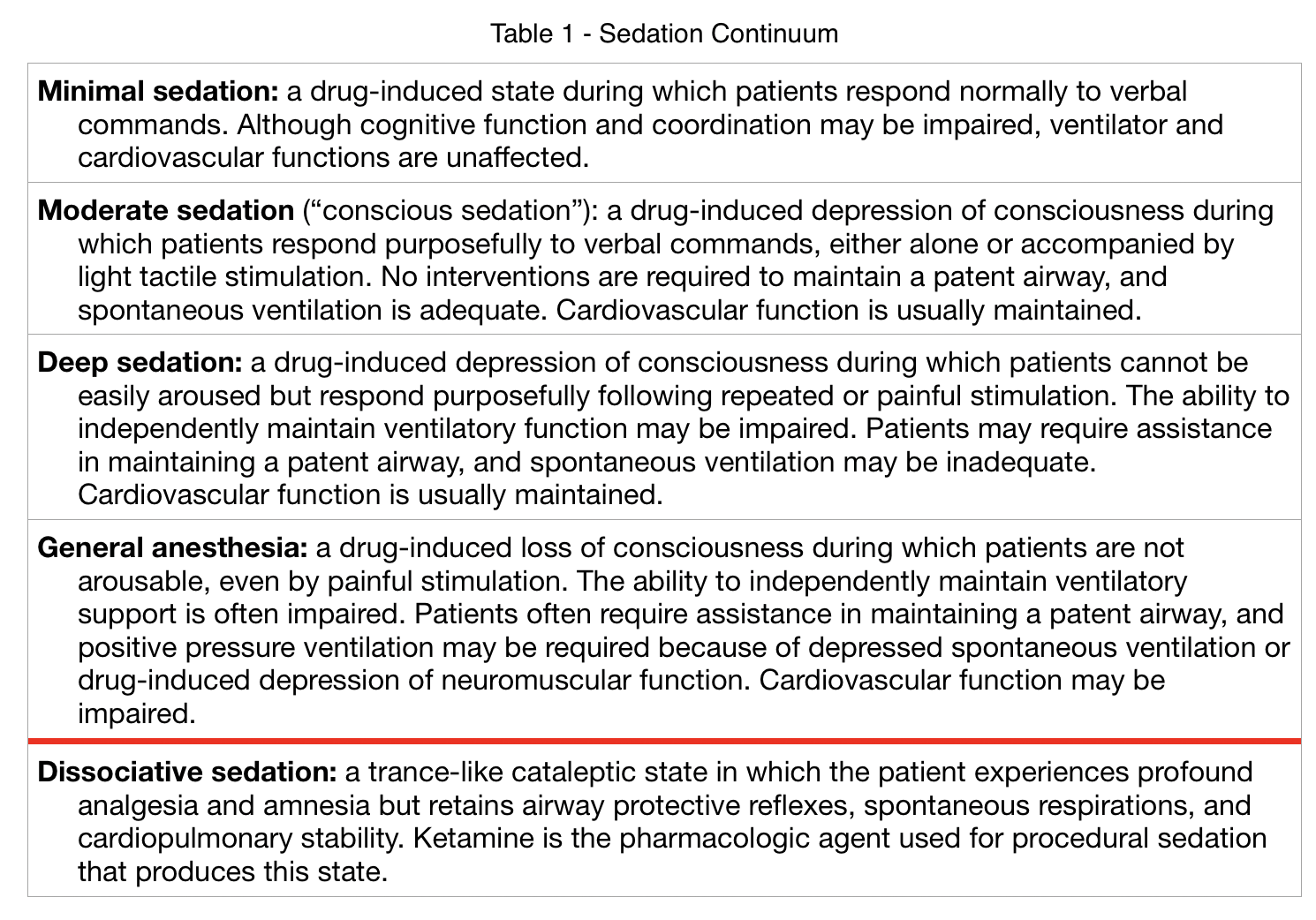
The Sedation Continuum from Conscious Sedation to General Anesthesia - Definitions

Minimal sedation: a drug-induced state during which patients respond normally to verbal
commands. Although cognitive function and coordination may be impaired, ventilator and
cardiovascular functions are unaffected.

Moderate sedation ("conscious sedation"): a drug-induced depression of consciousness during
which patients respond purposefully to verbal commands, either alone or accompanied by
light tactile stimulation. No interventions are required to maintain a patent airway, and
spontaneous ventilation is adequate. Cardiovascular function is usually maintained.

Deep sedation: a drug-induced depression of consciousness during which patients cannot be
easily aroused but respond purposefully following repeated or painful stimulation. The ability to
independently maintain ventilatory function may be impaired. Patients may require assistance
in maintaining a patent airway, and spontaneous ventilation may be inadequate.
Cardiovascular function is usually maintained.

General anesthesia: a drug-induced loss of consciousness during which patients are not
arousable, even by painful stimulation. The ability to independently maintain ventilatory
support is often impaired. Patients often require assistance in maintaining a patent airway, and
positive pressure ventilation may be required because of depressed spontaneous ventilation or
drug-induced depression of neuromuscular function. Cardiovascular function may be
impaired.

Dissociative sedation: a trance-like cataleptic state in which the patient experiences profound
analgesia and amnesia but retains airway protective reflexes, spontaneous respirations, and
cardiopulmonary stability. Ketamine is the pharmacologic agent used for procedural sedation
that produces this state.

#Sedation #Definitions #Anesthesia #General #Conscious #Continuum