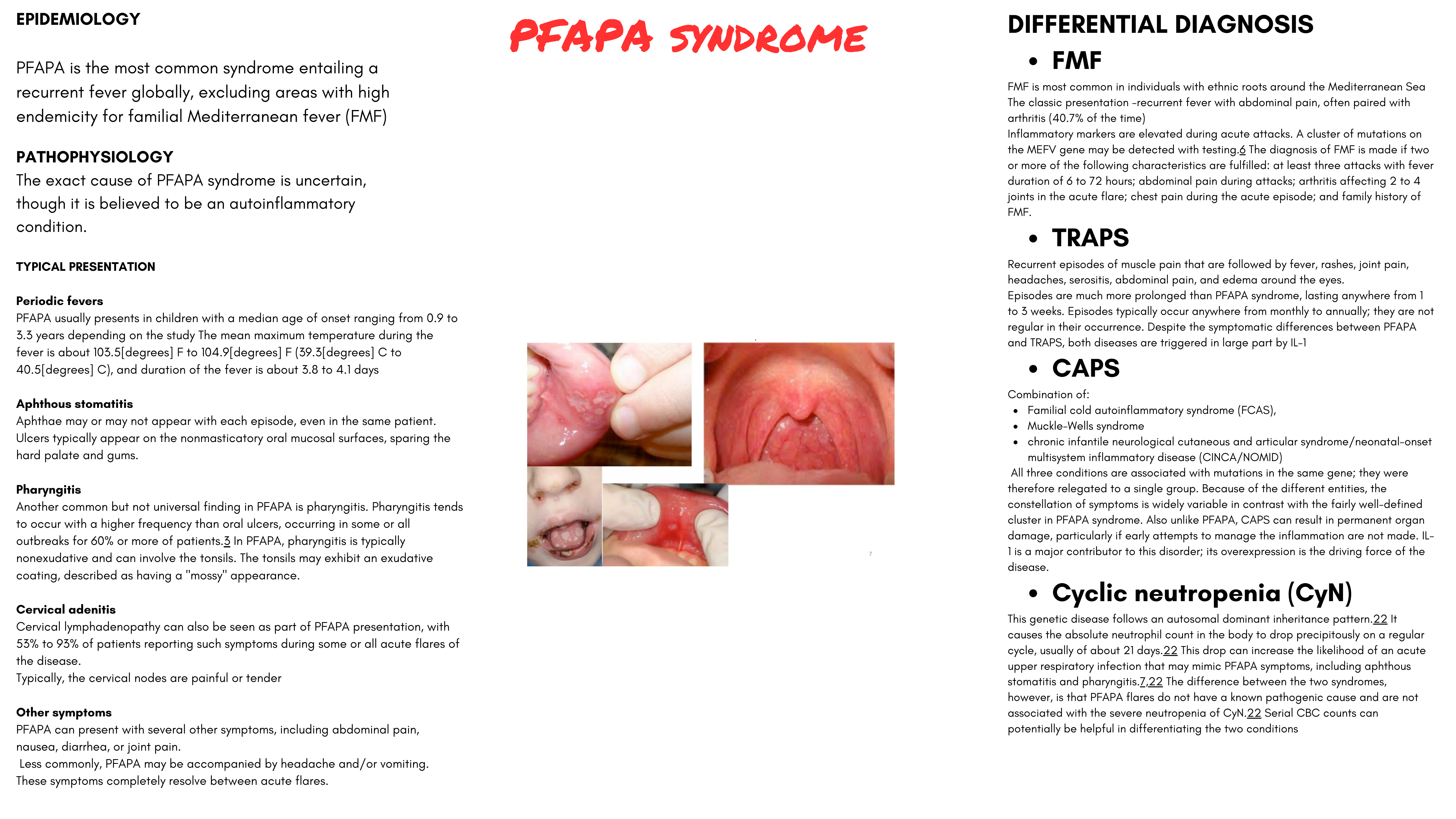
PFAPA Syndrome - Periodic Fever, Aphthous Stomatitis, Pharyngitis, and Adenitis

EPIDEMIOLOGY:
PFAPA is the most common syndrome entailing a recurrent fever globally, excluding areas with high endemicity for familial Mediterranean fever (FMF)

PATHOPHYSIOLOGY:
The exact cause of PFAPA syndrome is uncertain, though it is believed to be an autoinflammatory condition.

TYPICAL PRESENTATION:
 • Periodic fevers - PFAPA usually presents in children with a median age of onset ranging from 0.9 to 3.3 years depending on the study. The mean maximum temperature during the fever is about 103.5°F to 104.9°F (39.7°C to 40.5°C), and duration of the fever is about 3.8 to 4.1 days
 • Aphthous stomatitis - Apthae may or may not appear with each episode, even in the same patient. Ulcers typically appear on the nonmasticatory oral mucosal surfaces, sparing the hard palate and gums.
 • Pharyngitis - Another common but not universal finding in PFAPA is pharyngitis. Pharyngitis tends to occur with a higher frequency than oral ulcers, occurring in some or all outbreaks for 60% or more of patients. In PFAPA, pharyngitis is typically nonexudative and can involve the tonsils. The tonsils may exhibit an exudative coating, described as having a “mossy” appearance.
 • Cervical adenitis - Cervical lymphadenopathy can also be seen as part of PFAPA presentation, with 53% to 93% of patients reporting such symptoms during some or all acute flares of the disease. Typically, the cervical nodes are painful or tender
 • Other symptoms - PFAPA can present with several other symptoms, including abdominal pain, nausea, diarrhea, or joint pain.  Less commonly, PFAPA may be accompanied by headache and/or vomiting. These symptoms completely resolve between acute flares.

DIFFERENTIAL DIAGNOSIS
• FMF - FMF is most common in individuals with ethnic roots around the Mediterranean Sea.
The classic presentation - recurrent fever with abdominal pain, often paired with arthritis (40.7% of the time).
Inflammatory markers are elevated during acute attacks. A cluster of mutations on the MEFV gene may be detected with testing. The diagnosis of FMF is made if two or more of the following characteristics are fulfilled: at least three attacks with fever duration of 6 to 72 hours; abdominal pain during attacks; arthritis affecting 2 to 4 joints in the acute flare; chest pain during the acute episode; and family history of FMF.
• TRAPS - Recurrent episodes of muscle pain that are followed by fever, rashes, joint pain, headaches, serositis, abdominal pain, and edema around the eyes. Episodes are much more prolonged than PFAPA syndrome, lasting anywhere from 1 to 3 weeks. Episodes typically occur anywhere from monthly to annually; they are not regular in their occurrence. Despite the symptomatic differences between PFAPA and TRAPS, both diseases are triggered in large part by IL-1
• CAPS
Combination of:
  - Familial cold autoinflammatory syndrome (FCAS),
  - Muckle–Wells syndrome
  - chronic infantile neurological cutaneous and articular syndrome/neonatal-onset multisystem inflammatory disease (CINCA/NOMID)
All three conditions are associated with mutations in the same gene; they were therefore relegated to a single group. Because of the different entities, the constellation of symptoms is widely variable in contrast with the fairly well-defined cluster in PFAPA syndrome. Also unlike PFAPA, CAPS can result in permanent organ damage, particularly if early attempts to manage the inflammation are not made. IL-1 is a major contributor to this disorder; its overexpression is the driving force of the disease.

• Cyclic neutropenia (CyN)
This genetic disease follows an autosomal dominant inheritance pattern. It causes the absolute neutrophil count in the body to drop precipitously on a regular cycle, usually of about 21 days. This drop can increase the likelihood of an acute upper respiratory infection that may mimic PFAPA syndrome, including aphthous stomatitis and pharyngitis. The difference between the two syndromes, however, is that PFAPA flares do not have a known pathogenic cause and are not associated with the severe neutropenia of CyN. Serial CBC counts can potentially be helpful in differentiating the two conditions.

#PFAPA #Syndrome #Diagnosis #Fever #Diagnosis


