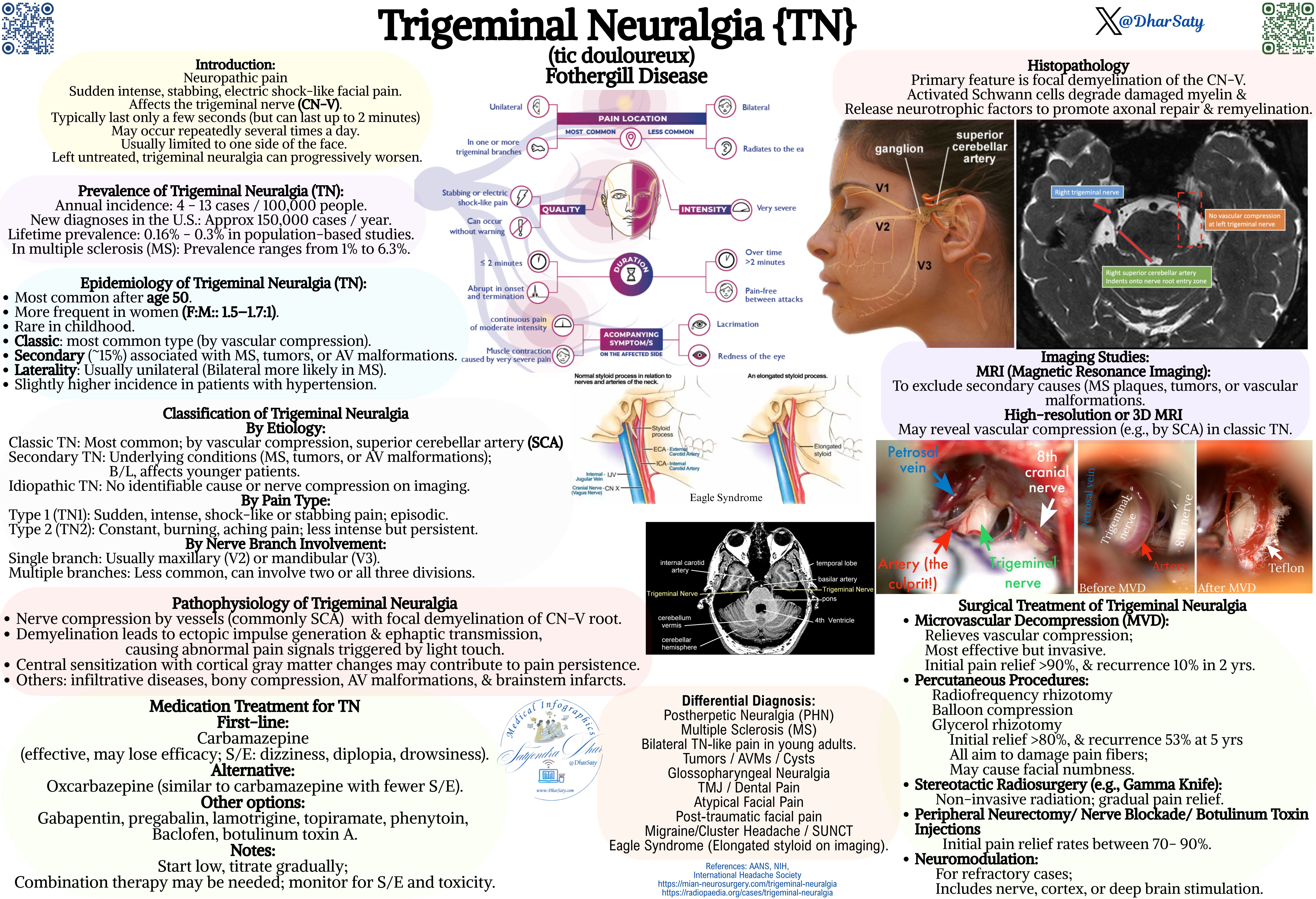
Trigeminal neuralgia (tic douloureux):

"Imagine your face has a super-sensitive alarm system—the trigeminal nerve. It’s supposed to quietly handle sensations like touch, warmth, or a gentle breeze. But with trigeminal neuralgia, that system goes haywire. Suddenly, even mild triggers like brushing your teeth, talking, or a light wind can set off intense, electric-shock-like pain. It’s like your nerve’s alarm is stuck on high alert, firing off pain signals when it shouldn’t.

The cause? Often, a blood vessel pressing on the nerve—or sometimes multiple sclerosis or other conditions—can irritate or damage the nerve’s protective covering.

Historically, trigeminal neuralgia was first described in the 17th century by physician Johannes Bausch. It was later more clearly defined in the 18th century by John Fothergill, who provided one of the earliest clinical descriptions, leading to the term “Fothergill’s disease.” The condition has long been recognized as one of the most severe forms of facial pain in medical literature."

#USMLE #Medstudent #MedTwitter #MedicalEducation #trigeminal #neuralgia #aafp


