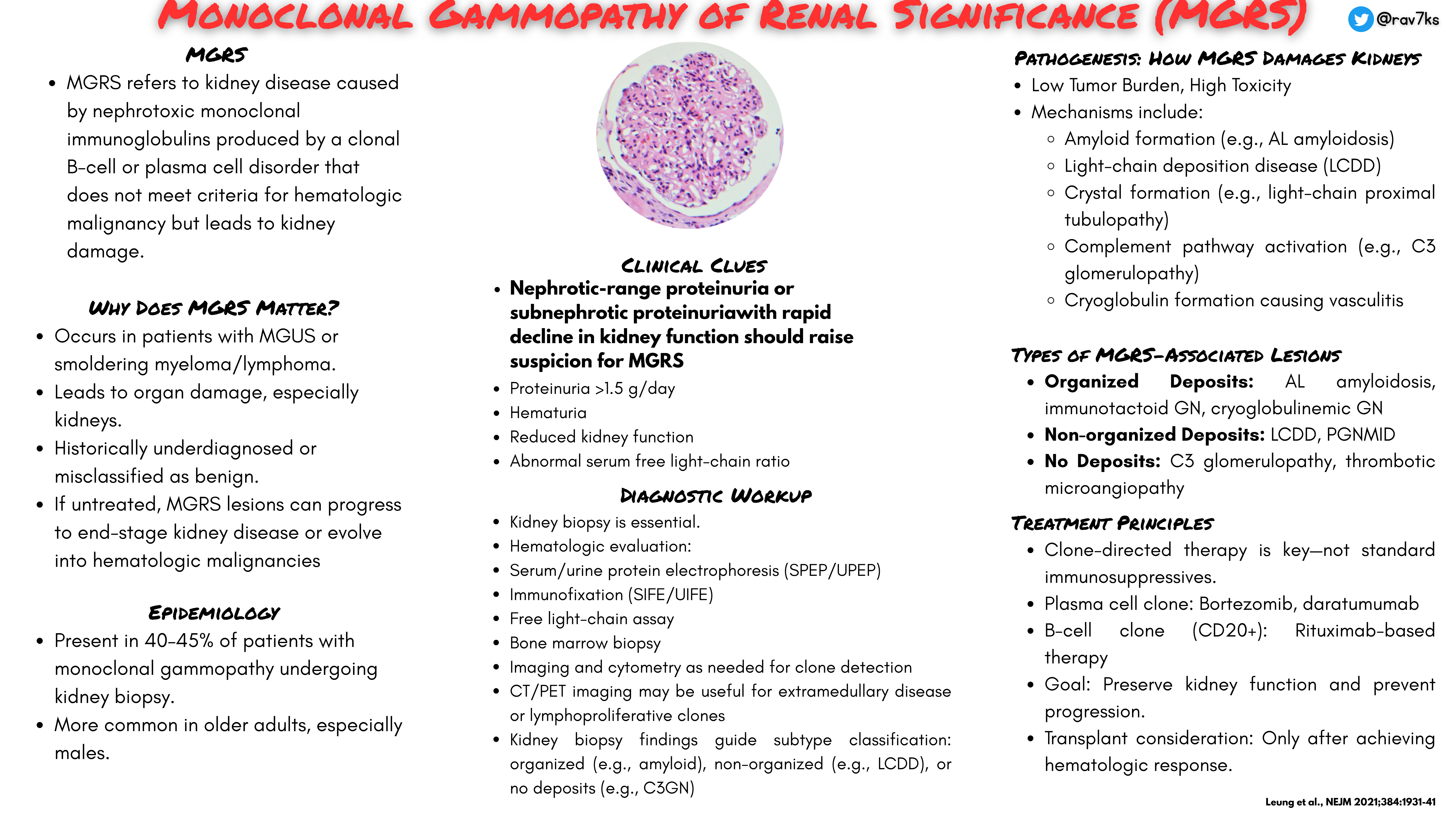
Monoclonal Gammopathy of Renal Significance (MGRS)

MGRS
• MGRS refers to kidney disease caused by nephrotoxic monoclonal immunoglobulins produced by a clonal B-cell or plasma cell disorder that does not meet criteria for hematologic malignancy but leads to kidney damage.

Why Does MGRS Matter?
• Occurs in patients with MGUS or smoldering myeloma/lymphoma.
• Leads to organ damage, especially kidneys.
• Historically underdiagnosed or misclassified as benign.
• If untreated, MGRS lesions can progress to end-stage kidney disease or evolve into hematologic malignancies.

Epidemiology:
• Present in 40–45% of patients with monoclonal gammopathy undergoing kidney biopsy.
• More common in older adults, especially males.

Clinical Clues:
• Nephrotic-range proteinuria or subnephrotic proteinuria with rapid decline in kidney function should raise suspicion for MGRS
• Proteinuria >1.5 g/day
• Hematuria
• Reduced kidney function
• Abnormal serum free light-chain ratio

Diagnostic Workup:
• Kidney biopsy is essential.
• Serum/urine protein electrophoresis (SPEP/UPEP)
• Immunofixation (SIFE/UIFE)
• Free light-chain assay
• Bone marrow biopsy
• Imaging and cytometry as needed for clone detection
• CT/PET imaging may be useful for extramedullary disease or lymphoproliferative clones
• Kidney biopsy findings guide subtype classification: organized (e.g., amyloid), non-organized (e.g., LCDD), or no deposits (e.g., C3GN)

Pathogenesis: How MGRS Damages Kidneys
• Low Tumor Burden, High Toxicity
• Mechanisms include:
   - Amyloid formation (e.g., AL amyloidosis)
   - Light-chain deposition disease (LCDD)
   - Crystal formation (e.g., light-chain proximal tubulopathy)
   - Complement pathway activation (e.g., C3 glomerulopathy)
   - Cryoglobulin formation causing vasculitis

Types of MGRS-Associated Lesions:
• Organized Deposits: AL amyloidosis, immunotactoid GN, cryoglobulinemic GN
• Non-organized Deposits: LCDD, PGNMID
• No Deposits: C3 glomerulopathy, thrombotic microangiopathy

Treatment Principles:
• Clone-directed therapy is key—not standard immunosuppressives.
• Plasma cell clone: Bortezomib, daratumumab
• B-cell clone (CD20+): Rituximab-based therapy
• Goal: Preserve kidney function and prevent progression.
• Transplant consideration: Only after achieving hematologic response.

#MGRS #Monoclonal #Gammopathy #Renal #Significance #Diagnosis


