Hepatorenal Syndrome (HRS)

Definition:
• Functional, potentially reversible kidney impairment.
• Occurs in advanced liver disease: cirrhosis, severe alcoholic hepatitis, or acute liver failure.
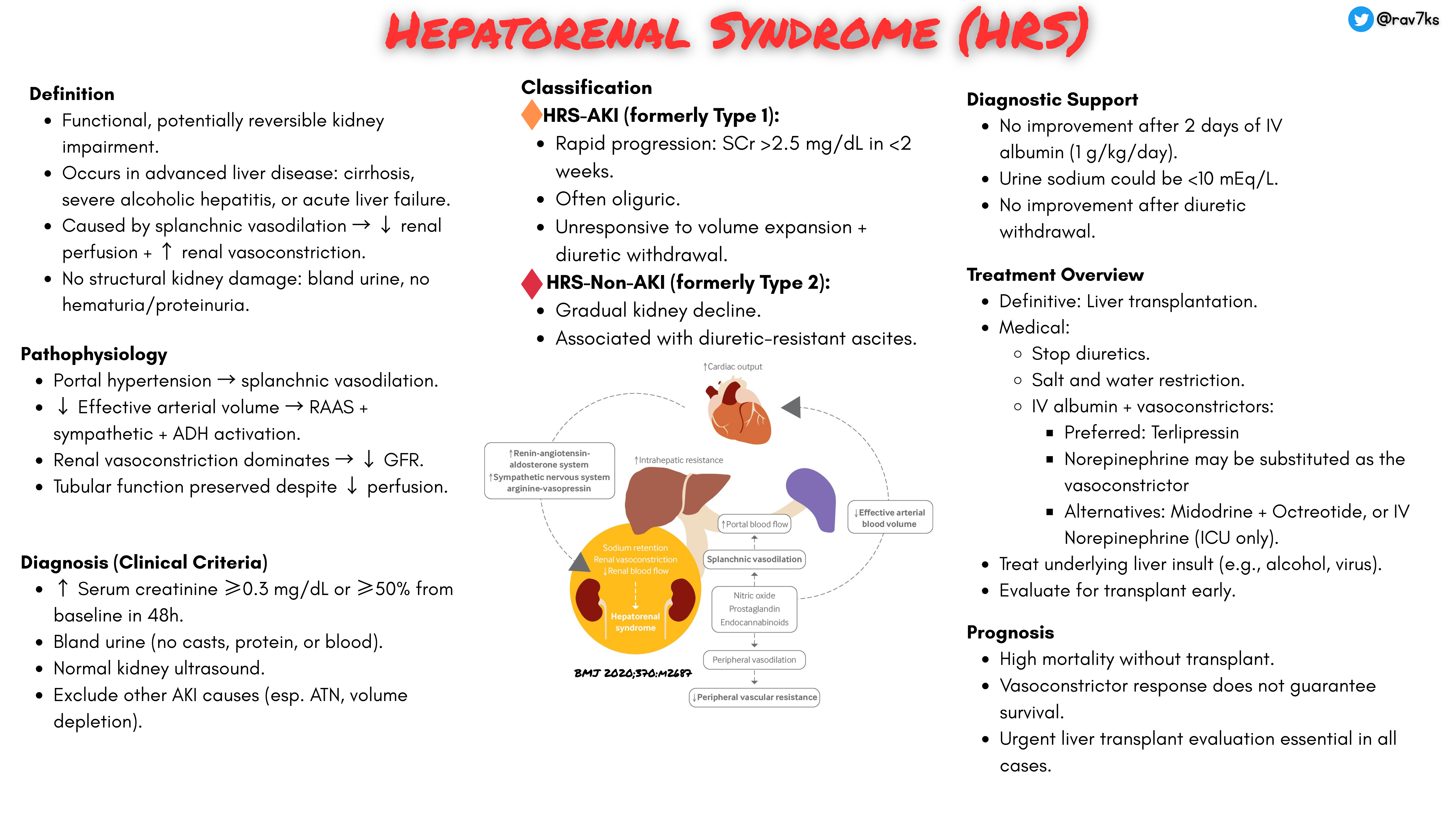
• Caused by splanchnic vasodilation → ↓ renal perfusion + ↑ renal vasoconstriction.
• No structural kidney damage: bland urine, no hematuria/proteinuria.

Pathophysiology:
• Portal hypertension → splanchnic vasodilation.
• ↓ Effective arterial volume → RAAS + sympathetic + ADH activation.
• Renal vasoconstriction dominates → ↓ GFR.
• Tubular function preserved despite ↓ perfusion.

Diagnosis (Clinical Criteria):
• ↑ Serum creatinine ≥0.3 mg/dL or ≥50% from baseline in 48h.
• Bland urine (no casts, protein, or blood).
• Normal kidney ultrasound.
• Exclude other AKI causes (esp. ATN, volume depletion).

Classification:
HRS-AKI (formerly Type 1):
• Rapid progression: SCr >2.5 mg/dL in <2 weeks.
• Often oliguric.
• Unresponsive to volume expansion + diuretic withdrawal.
HRS-Non-AKI (formerly Type 2):
• Gradual kidney decline.
• Associated with diuretic-resistant ascites.

Diagnostic Support:
• No improvement after 2 days of IV albumin (1 g/kg/day).
• Urine sodium could be <10 mEq/L.
• No improvement after diuretic withdrawal.

Treatment Overview:
• Definitive: Liver transplantation.
• Medical:
   - Stop diuretics.
   - Salt and water restriction.
   - IV albumin + vasoconstrictors:
      - Preferred: Terlipressin
      - Norepinephrine may be substituted as the vasoconstrictor
      - Alternatives: Midodrine + Octreotide, or IV Norepinephrine (ICU only).
• Treat underlying liver insult (e.g., alcohol, virus).
• Evaluate for transplant early.

Prognosis:
• High mortality without transplant.
• Vasoconstrictor response does not guarantee survival.
• Urgent liver transplant evaluation essential in all cases.

#HRS #Hepatorenal #Syndrome #Hepatology #Nephrology #Diagnosis