SEPSIS AND SEPTIC SHOCK

DEFINITION AND PATHOPHYSIOLOGY
 • Sepsis: Life-threatening organ dysfunction due to a dysregulated host response to infection.
 • Septic shock: A subset with circulatory and cellular/metabolic dysfunction requiring vasopressors to maintain MAP >= 65 mm Hg and lactate > 2 mmol/L despite fluids.
 • Pathophysiology: Excessive inflammation + immune suppression + microvascular injury -> multi-organ failure.
 • 2001 SIRS: Host inflammatory response to infection and injury.
 • 2016 Consensus conference SEPSIS-3 (2 categories):
      - Sepsis (Without Shock): Infection + Organ dysfunction.
      - Sepsis with Shock: Sepsis + Fluid resistant Hypotension (MAP > 65 + Lactate => 2 mmol/L).

EPIDEMIOLOGY
 • 49 million cases and 11 million deaths globally each year.
 • In the U.S., accounts for > 1/3 of in-hospital deaths.

BIOLOGICAL FEATURES
 • Hyperinflammation: Neutrophil traps (NETs), cytokines, complement activation.
 • Immunosuppression: Lymphopenia (Increased risk death), T-cell exhaustion, monocyte dysfunction/hypofunction. Neutrophils- hypofunctional, increased Myelopoiesis.
 • Vascular injury: Glycocalyx loss, increased permeability, microthrombosis, decreased Fibrinolysis. Hypotension, third spacing of fluid and sometimes DIC.

COMMON CAUSES + RISK FACTORS
 • Sites of infection: Lungs (40-60%), abdomen, GU tract, bloodstream, skin/soft tissue.
 • Pathogens: Gram-positive/-negative bacteria, fungi (e.g., Candida), viruses.
 • Risk factors: Advanced age, immunosuppression, chronic illness (e.g., ESRD, cancer), indwelling devices.

CLINICAL RECOGNITION
 • Suspect in any acutely ill patient with infection + organ dysfunction.
 • Symptoms: Fever/hypothermia, altered mentation, dyspnea, oliguria, hypotension, tachypnea.
 • Labs: increased Lactate, leukocytosis/leukopenia, increased Cr, hyperglycemia, thrombocytopenia.

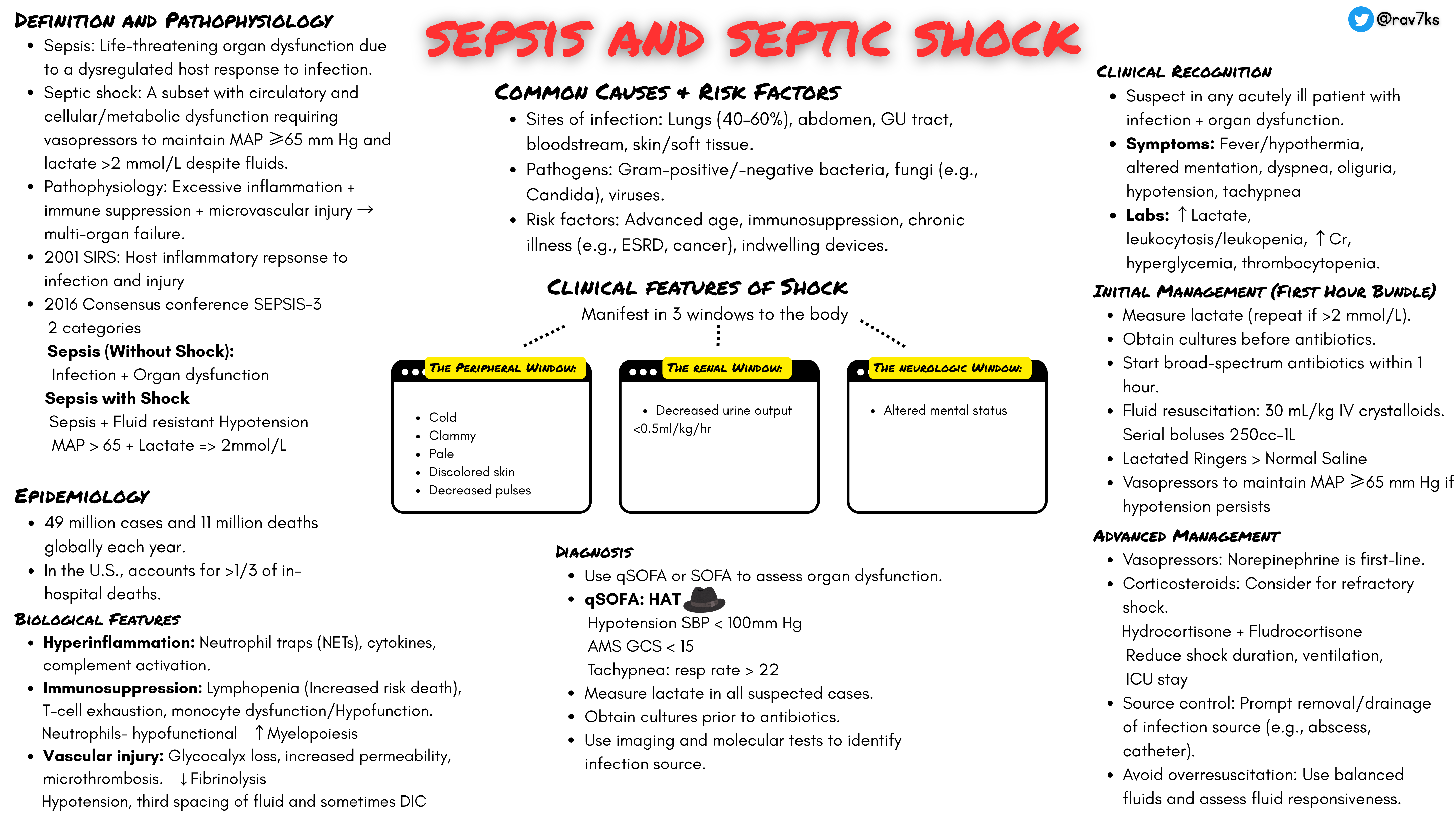
CLINICAL FEATURES OF SHOCK (Manifest in 3 windows to the body)
 • The Peripheral Window:
      - Cold
      - Clammy
      - Pale
      - Discolored skin
      - Decreased pulses
 • The Renal Window:
      - Decreased urine output < 0.5 ml/kg/hr
 • The Neurologic Window:
      - Altered mental status

DIAGNOSIS
 • Use qSOFA or SOFA to assess organ dysfunction.
 • qSOFA: HAT
      - Hypotension SBP < 100 mm Hg
      - AMS GCS < 15
      - Tachypnea: resp rate > 22
 • Measure lactate in all suspected cases.
 • Obtain cultures prior to antibiotics.
 • Use imaging and molecular tests to identify infection source.

INITIAL MANAGEMENT (FIRST HOUR BUNDLE)
 • Measure lactate (repeat if > 2 mmol/L).
 • Obtain cultures before antibiotics.
 • Start broad-spectrum antibiotics within 1 hour.
 • Fluid resuscitation: 30 mL/kg IV crystalloids. Serial boluses 250cc-1L.
 • Lactated Ringers > Normal Saline.
 • Vasopressors to maintain MAP >= 65 mm Hg if hypotension persists.

ADVANCED MANAGEMENT
 • Vasopressors: Norepinephrine is first-line.
 • Corticosteroids: Consider for refractory shock. Hydrocortisone + Fludrocortisone. Reduce shock duration, ventilation, ICU stay.
 • Source control: Prompt removal/drainage of infection source (e.g., abscess, catheter).
 • Avoid overresuscitation: Use balanced fluids and assess fluid responsiveness.

#Sepsis #Septicshock #Septic #Shock #Diagnosis #Management